Open source public alert broadcaster

Official alerts that reach beyond the cell network.

MeshWX watches National Weather Service weather alerts and FEMA IPAWS public safety alerts, then broadcasts the warnings that matter over Meshtastic, MeshCore, or both. One self-hosted dashboard keeps your local mesh informed when severe weather or a local emergency develops.

NWS + FEMA IPAWS Meshtastic + MeshCore No account or cloud Windows, Pi, and Docker
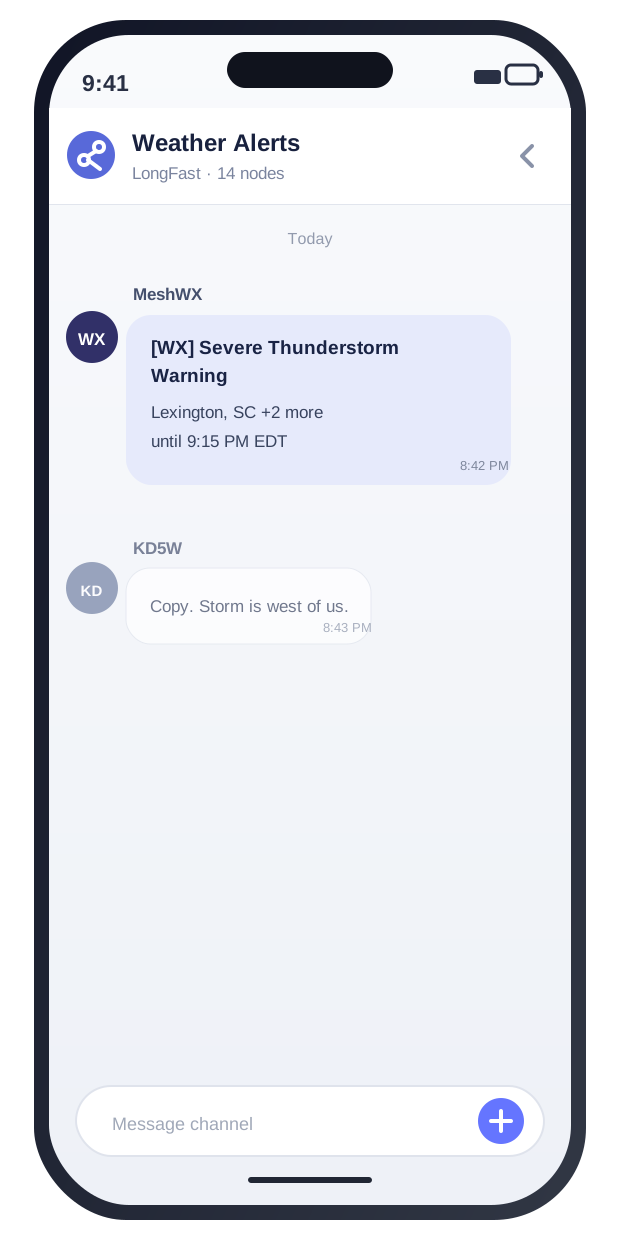
MeshWX severe thunderstorm warning displayed in the Meshtastic phone app
Meshtastic
MeshWX tornado warning displayed in the MeshCore phone app
MeshCore
2official alert sources
195byte message limit
0cloud accounts required
24/7automatic alert monitoring
One dashboard. Two mesh networks.

Watch weather and public safety alerts. See every broadcast.

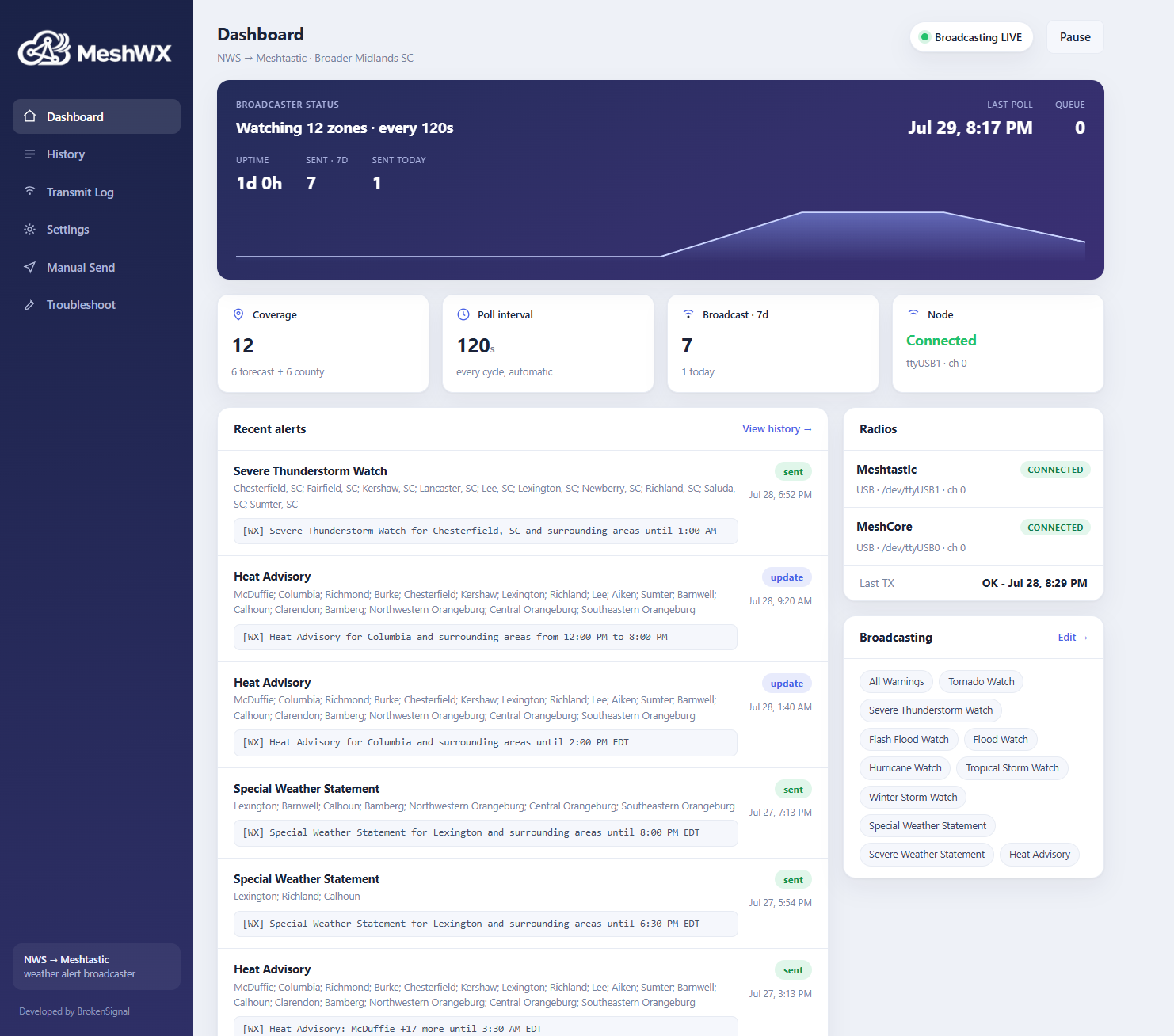
MeshWX keeps separate histories for NOAA weather and FEMA IPAWS alerts, shows both connected radios, and records every message sent to your local mesh.

meshwx.local
LIVE
MeshWX dashboard showing National Weather Service and FEMA IPAWS alerts with connected Meshtastic and MeshCore radios
Meshtastic

Send alerts to a familiar channel

Use a dedicated weather channel or the channel your group already monitors. MeshWX handles formatting, deduplication, updates, and cancellations.

  • Concise location and expiration time
  • Repeat sends for better delivery odds
  • Live and test channels stay separate
MeshCore

Keep off-grid users informed

Broadcast the same alert through a MeshCore USB companion radio, side by side with Meshtastic or on its own.

  • Run either platform or both together
  • Independent radio ports and channels
  • Bench-test each radio from the dashboard
Now with FEMA IPAWS

Public safety alerts beyond weather.

MeshWX can also monitor FEMA's Integrated Public Alert and Warning System and broadcast selected public safety alerts to your mesh.

Official public alerts

Choose the alerts your mesh should carry

Enable only the IPAWS categories that matter to your area and keep weather alerts separate from public safety traffic.

  • AMBER and child-abduction alerts
  • Civil danger, local emergencies, and evacuation orders
  • Shelter-in-place, hazardous materials, and law-enforcement warnings
  • 911 outages, nuclear incidents, boil-water notices, and other public safety alerts
Updates and cancellations

Send the alert, the update, and the all-clear

MeshWX tracks IPAWS alert identifiers and references so updates and cancellations can be broadcast instead of leaving an old warning hanging on the mesh.

  • Separate IPAWS history page
  • Optional test and exercise messages
  • Location filtering before transmission
  • LoRa-sized messages for Meshtastic and MeshCore
Built for resilient local communications

For the people who keep a mesh useful when conditions get bad.

MeshWX fits naturally into community and emergency communications systems that already use low-power LoRa radios.

Explore the open-source project

Local mesh operators

Add useful, automatic traffic to an existing Meshtastic or MeshCore community.

Emergency communications groups

Give groups another path for weather warnings, evacuation notices, shelter-in-place orders, and other official public alerts.

Prepared families and neighborhoods

Share critical weather and public safety information across properties where cellular coverage is weak.

Events, camps, and remote sites

Keep organizers and participants aware without depending on every phone having service.

Designed to run quietly in the background

Everything needed to turn official alerts into useful mesh traffic.

01

Two radios, one dashboard

Connect Meshtastic, MeshCore, or both. Each radio gets its own USB port, alert channel, repeat settings, and test control.

Smart filtering

Select counties, alert sources, and alert types from the interface instead of wrestling with zone codes or CAP data.

LoRa-sized messages

Long weather and IPAWS bulletins are reduced to the event, location, instruction, and expiration time within a 195-byte limit.

No duplicate noise

MeshWX remembers what it sent, only rebroadcasting meaningful updates and cancellations from NWS or IPAWS.

A dashboard worth checking

See connected radios, NOAA and IPAWS histories, transmission history, current coverage, and seven-day activity at a glance.

How it works

From NWS and FEMA IPAWS to the mesh in three steps.

Diagram showing official NWS and FEMA IPAWS alerts entering MeshWX, being filtered and shortened, sent through a connected Meshtastic or MeshCore radio, and spreading across the local mesh network
1

Watch your selected area

MeshWX polls the NWS and FEMA IPAWS feeds for the counties, forecast zones, and alert categories chosen in the dashboard.

2

Filter and format

Only enabled alert types move forward, then the key details are compressed into a clear mesh-sized message with updates and cancellations handled correctly.

3

Broadcast over LoRa

The alert is sent through each enabled radio and appears in the channels monitored by local users.

Install MeshWX

Choose your host and get running.

Windows users can download the latest release. Linux and Docker users can copy the commands below and install MeshWX directly.

Windows

Download the latest release

Download the Windows package, extract it, and launch MeshWX.

Open Windows releases
Linux / Raspberry Pi

Install as a system service

Run these commands in a terminal.

git clone https://github.com/BrokenSignal/MeshWX.git
cd MeshWX
sudo ./packaging/install-linux.sh
Docker

Run the published container

Copy the command below to deploy MeshWX with persistent storage and USB device access.

docker run -d --name meshwx \
  -p 8110:8000 \
  -v meshwx-data:/data \
  --device-cgroup-rule='c 188:* rmw' \
  --device-cgroup-rule='c 166:* rmw' \
  -v /dev:/dev \
  --restart unless-stopped \
  ghcr.io/brokensignal/meshwx:latest
Free, open source, and self-hosted

Give your mesh a direct line to official alerts.

Download the latest release, connect a compatible radio, and choose the NWS weather and FEMA IPAWS public safety alerts your community needs to receive.

Important: MeshWX is a supplemental tool, not a certified warning system. Keep an official source such as NOAA Weather Radio, wireless emergency alerts, or local sirens.